



Curriculum Implementation
Although many subjects are taught through themes that help children make meaningful links in their learning, we also ensure that every subject is valued in its own right. When elements of a subject do not fit meaningfully within a theme, they are taught discretely with their own planned learning journey. This means we still teach the Full National Curriculum, with each subject given the time, structure and progression it needs.
You can read more about each subject here.
Our thematic, inter-disciplinary approach
Within every theme, the knowledge and skills for each subject are clearly set out, planned in order and taught directly. This means children gain a strong understanding of each subject while still enjoying the connections themes create.
So, while pupils explore big ideas that link subjects together, they also learn to think like historians, scientists and geographers, developing the subject‑specific knowledge and skills they need. Our themes make learning engaging and purposeful, but the structure, progression and important vocabulary of each subject remain central to what we teach.
Our Curriculum Themes
As we have mixed-age classes, we plan our curriculum themes over a two-year-cycle. Some themes are revisited several times during a pupil's time at school - for example, Know your Place is covered in each class to develop the children's growing knowledge of the world around them. Planning themes in this way enables us to build on children's prior knowledge and helps them to make connections in their learning in meaningful ways.
For example, during the Know your Place theme each class has the focus below:
- Class 1 learn about Scarcliffe. They produce sketch maps and look at the facilities in the local area.
- Class 2 build on this by studying Bolsover. They visit Bolsover and draw and use simple OS maps. They create surveys to ask local residents.
- Class 3 go further afield and learn about Chesterfield. They learn about the physical and human features of the town and have a focus on historical elements.
- Class 4 complete a local history study about Derbyshire. They focus on the mining industry and how this has impacted on the local communities. Children compare detailed OS maps from now and in the past to explore how land-use has changed.
Other themes stand alone. This enables class teachers to ensure they cover all elements of the curriculum intent documents for every subject.
Click on the link below to see the theme titles for each class.
Curriculum Titles Overview
How our themes are structured
Our curriculum is taught through engaging themes that help children make meaningful links between ideas. Each theme contains carefully chosen content from different subjects and is planned in a logical order, using learning journeys so that learning builds over time. These themes spark curiosity, give learning real purpose and help children connect what they know.
Each of our themes is driven by a clear enquiry question. These big questions give learning a strong sense of purpose and help children see the relevance of what they are studying. Throughout the theme, pupils gather knowledge, explore ideas, and build understanding that helps them answer the enquiry question in increasing depth. This approach encourages curiosity, supports critical thinking and helps children make meaningful connections across subjects.
Our enquiry long-term overview, shows the themes and enquiry questions your child will explore across the year in each cycle. Each theme brings together learning from different subjects, while still keeping the important knowledge and skills of each subject clearly taught. The overview shows what children will learn each term, how subjects connect, and how learning builds as they move through school. It also ensures that, in our mixed‑age classes, every child receives full coverage of the National Curriculum over the two‑year cycle.
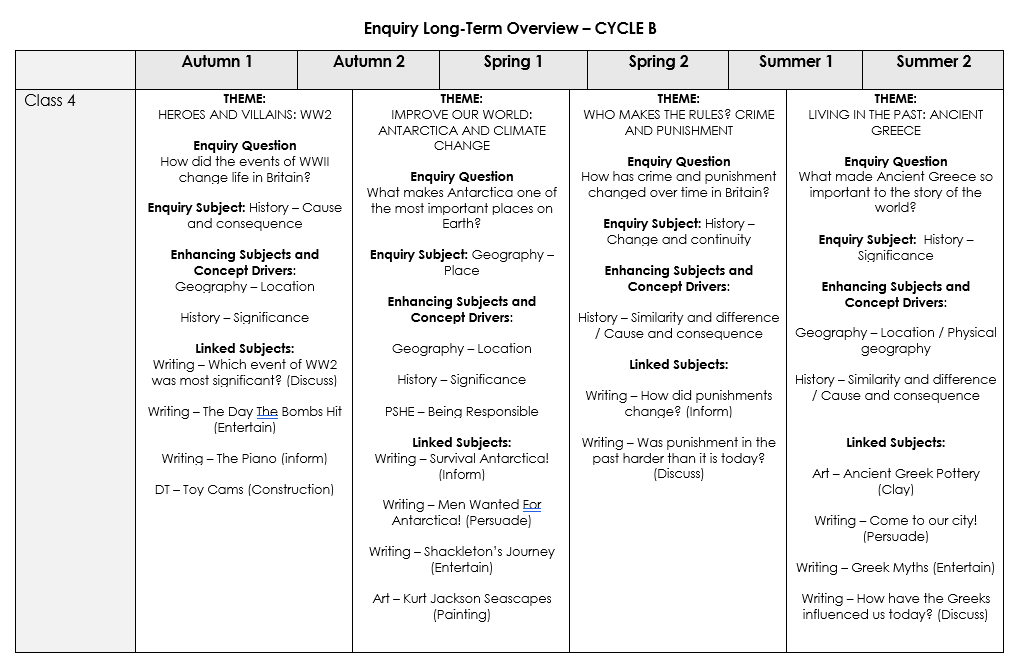
You can view the full overview for Cycle B (2025-2026) here.
How we teach substantive and disciplinary knowledge
Within every theme, the knowledge for each subject is clearly set out:
- Substantive knowledge – the key facts, vocabulary and information children need to learn.
- Disciplinary knowledge – how children “think like a specialist”. For example, historians look at evidence and think about causes and consequences, while scientists test ideas and look for patterns.
By teaching both clearly, children not only learn what they need to know, but also how to use that knowledge in meaningful ways. This helps them develop confidence, independence and deeper understanding.
How we ensure progression in mixed‑age classes
Because we have mixed‑age classes, we plan our curriculum over a two‑year cycle. This means:
- every child learns all the necessary content for their year group
- challenge increases as children move up the school
Each subject has a clear progression document so teachers always know what has been taught before and what comes next.
Using retrieval practice ("Can you still...?")
To help children remember important knowledge over time, teachers regularly revisit past learning. Our “Can you still…?” questions are used in lessons to prompt recall, strengthen memory and help children connect old learning with new ideas. This supports long‑term understanding and confidence.
Using knowledge organisers
Every theme includes a knowledge organiser that highlights the most important vocabulary, facts and concepts children need to know. These help:
- teachers to keep learning focused
- children know more, remember more and do more over time
They are a simple but powerful way of building memory over time. You can find examples of knowledge organisers on the class pages here.
How reading, writing and maths run through the curriculum
Even though our themes cover a wide range of subjects, reading, writing and maths remain at the heart of everything we do. Children read widely for information, write for different audiences and purposes linked to their themes and apply mathematical skills in real contexts. This strengthens core skills while adding purpose. Teaching early reading is also a key priority, as we know it is the key to unlocking children’s ability to access all areas of learning.
How we use assessment
We want every child at Scarcliffe to leave us confident, curious and well‑prepared for the next stage of their education. To ensure this, we continually check what pupils know, understand and can do. Assessment is woven naturally into everyday teaching: teachers question, observe and look closely at children’s work to identify strengths and address any gaps. Alongside this ongoing assessment, we also use:
- pre‑tests to find out what children already know
- post‑tests to check what has been remembered
- disciplinary tasks (e.g., historical enquiries, scientific investigations) to see how well children can use their knowledge
This balanced approach helps us tailor teaching, secure long‑term learning and provide timely support where needed.
Co-curriculum - Widening pupil experiences
Our curriculum aims to inspire a genuine love of learning. We focus on building cultural capital, broadening vocabulary and nurturing children’s natural curiosity. Enrichment is an important part of this: trips, residentials, specialist visitors, clubs, themed days and inter‑school activities all give pupils real‑world experiences that bring learning to life. These opportunities help children deepen their understanding of the world and support their social, moral, spiritual and cultural development. Read more about our co-curricular offer here.
Want to know more?
Visit our class pages to find out more information about what is covered in each theme.